
How Much Is a Slip and Fall Case Worth in Pennsylvania?
Key Takeaways: There is no fixed average slip and fall settlement in Pennsylvania because each case is valued on its own facts, including injury severity, liability evidence, medical treatment, and lost income. Pennsylvania recognizes economic, non-economic, and in limited cases punitive damages, with documented losses forming the strongest foundation for value. Recovery rests on premises liability principles, requiring proof that the owner owed a duty, breached it through an unsafe condition, and caused your injuries. Strict deadlines apply, including a two-year statute of limitations under 42 Pa. Cons. Stat. § 5524 and as little as six months’ notice for government property claims. Settlements stay private and are not admissions of fault under 42 Pa. Cons. Stat. § 6141.
There is no single dollar figure that defines the average slip and fall settlement in Pennsylvania. Settlement value depends on injury severity, liability evidence strength, medical care required, and income lost during recovery. While minor cases may resolve for a few thousand dollars and serious injuries can settle for far more, your claim is worth what you can prove. Understanding the legal framework helps you set realistic expectations before speaking with an insurance adjuster.
If you were hurt on someone else’s property in Pennsylvania, the team at The Injury Pros can help you understand your options. Call us at 215-642-2335 for a confidential conversation, or reach out through our online case review form to get started today.
💡 Pro Tip: Keep every medical bill, pharmacy receipt, and pay stub from the time of your injury forward. Documentation is the backbone of any settlement valuation, and gaps in your records can quietly reduce what you recover.

What Shapes the Average Slip and Fall Settlement in Pennsylvania
Several distinct factors combine to determine the average slip and fall settlement in Pennsylvania. Insurance carriers and courts examine the hazard’s nature, fault clarity, medical treatment, and long-term life impact. A fractured hip requiring surgery and months of physical therapy supports far higher value than a sprained wrist healing in weeks. Because outcomes are fact-dependent, anyone promising a specific number before reviewing your records is overstating what the law allows.
Fall injuries are taken seriously because of their frequency and consequences. According to national fall injury data, over 14 million older adults report falling annually, with about 37% requiring medical treatment or activity restriction, resulting in approximately nine million fall injuries. These figures explain why property owners owe a real duty to maintain reasonably safe premises.
Older adults face especially serious risk. Falls are the leading cause of fatal and nonfatal injuries among older adults, with the age-adjusted death rate increasing 21% from 64.7 per 100,000 in 2018 to 78.4 per 100,000 in 2024. When a vulnerable person suffers a catastrophic fall, damages can be substantial, though actual recovery still depends on proof of negligence.
The Damages That Drive Your Claim Value
Pennsylvania law recognizes three categories of damages, each contributing differently to slip and fall compensation in PA. Understanding these categories helps you see where settlement value actually comes from.
- Economic damages cover lost wages, medical bills, and other measurable financial losses from your injury.
- Non-economic damages compensate for pain and suffering, which is harder to quantify but very real.
- Punitive damages apply only where conduct was outrageous, showing intentional wrongdoing or reckless indifference to safety. They are not available against government entities and are rare in ordinary slip and fall cases.
Economic damages are the most straightforward because they rest on documents. Hospital invoices, surgical costs, rehabilitation charges, and proof of missed work build this figure. The clearer your paper trail, the stronger your position when negotiating a premises liability settlement in PA.
💡 Pro Tip: Non-economic damages often hinge on credible testimony about how your injury changed daily life. A short journal noting pain levels, missed activities, and emotional strain can meaningfully support this part of your claim.
| Damage Type | What It Covers | How It Is Proven |
|---|---|---|
| Economic | Medical bills, lost wages, future care | Records, invoices, pay stubs |
| Non-economic | Pain, suffering, loss of enjoyment | Testimony, medical opinion, journals |
| Punitive | Intentional or reckless conduct | Evidence of egregious behavior |
Premises Liability: The Legal Foundation of Your Claim
Slip and fall cases generally rise or fall on premises liability, which governs injuries on someone else’s property. Pennsylvania applies a negligence framework requiring you to show the property owner owed you a duty of care, breached that duty through an unsafe condition or failure to warn, and caused your measurable injuries. Each element matters, and weakness in any one can undercut the whole claim. The duty’s scope depends on your status on the property, as Pennsylvania extends different protections to invitees, licensees, and trespassers.
Duty of Care and Breach
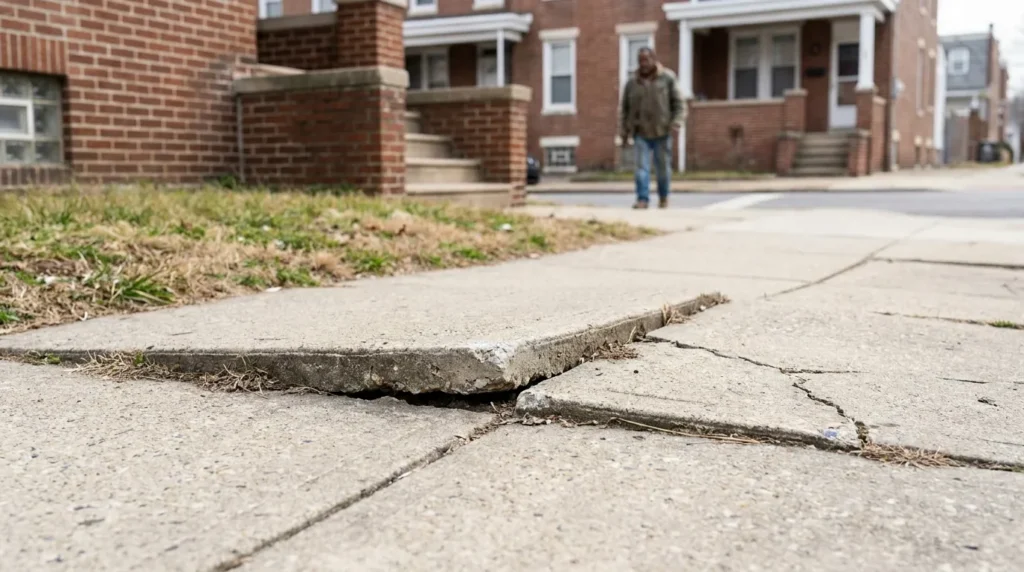
Property owners in Pennsylvania must maintain reasonably safe conditions for lawful visitors. Slip and fall cases are among the most common personal injury matters because owners do not always meet that standard. A wet floor without warning, a broken stair, or an unlit walkway can each represent a breach of duty. Whether a hazard amounts to negligence is a fact-sensitive question courts evaluate based on circumstances.
Notice and Constructive Notice
A central question in any slip and fall claim is whether the owner knew, or should have known, about the danger. This is the issue of actual or constructive notice. If a spill existed long enough that a reasonable owner should have discovered and addressed it, that can support a breach finding. Foreseeability often plays a role, because a hazard an owner could reasonably anticipate is harder to excuse.
Claims Against Government Property
Claims involving public property follow stricter rules you should understand early. Pennsylvania retains sovereign immunity for the state and governmental immunity for local governments, limiting many slip and fall claims against public entities. Narrow statutory exceptions exist, including a real property exception for dangerous conditions on government-owned land under the Sovereign Immunity Act. Even when exceptions apply, recovery is capped by statute and certain damages like pain and suffering are available only in limited circumstances.
💡 Pro Tip: If your fall happened in a city building, transit station, or other public facility, treat the deadline as urgent. Government claim rules can require notice in a fraction of the time allowed for ordinary cases.
Deadlines That Can Make or Break Your Claim
Pennsylvania imposes a two-year statute of limitations for personal injury claims under 42 Pa. Cons. Stat. § 5524. This period generally begins from your accident date. Missing it can end an otherwise strong case. The deadline is a civil filing rule distinct from administrative notice requirements for government claims.
Certain narrow circumstances may extend the deadline, but they are interpreted strictly. For example, where the injured person was an unemancipated minor on the accident date, the limitations period generally does not begin until the minor turns eighteen. Tolling applies only in limited situations, and courts do not presume exceptions. If unsure how the deadline affects you, act promptly rather than assume an exception applies.
Government-related claims involve a separate and much shorter administrative deadline. If your fall occurred in a public facility such as a city office or DMV location, you generally have only six months under 42 Pa. Cons. Stat. § 5522 to send official notification. Late or missing notice may be excused in limited situations, such as where the government unit already had notice of the condition. This administrative deadline is independent of the two-year civil statute, and both can apply to the same incident. A knowledgeable slip and fall lawyer PA can help you identify which deadlines control your situation.
Why Settlements Stay Private in Pennsylvania
Pennsylvania law protects the settlement process in ways that influence how cases resolve. Under 42 Pa. Cons. Stat. § 6141(a), a settlement or payment to an injured person does not constitute an admission of liability unless the parties agree otherwise. This settlement evidence statute encourages defendants to negotiate without conceding fault, which is one reason many slip and fall matters resolve before trial.
Settlement communications are generally shielded from being used as trial evidence. Section 6141(c) provides that such settlements or payments are not admissible in evidence at trial. This protection gives both sides room to discuss resolution candidly. Deciding whether to accept an offer or proceed to litigation is a significant choice, and it can help to consult a lawyer before signing anything.
💡 Pro Tip: Once you accept a settlement and sign a release, the matter is generally final. Be certain that future medical needs and ongoing losses are accounted for before agreeing to any PA slip and fall claim value.
Frequently Asked Questions
1. Is there a guaranteed average payout for a slip and fall in PA?
No reliable single average exists. Each fall accident settlement in Pennsylvania reflects unique injuries, evidence, and losses. Two cases with similar accidents can resolve very differently based on proof and severity.
2. How long do I have to file a slip and fall lawsuit in Pennsylvania?
You generally have two years from the accident date under 42 Pa. Cons. Stat. § 5524. Limited exceptions, such as those involving minors, may extend this period in narrow circumstances. Acting promptly is the safest course.
3. Does a settlement mean the property owner admitted fault?
Not under Pennsylvania law, unless the parties specifically agree otherwise. As 42 Pa. Cons. Stat. § 6141(a) provides, a settlement payment is not an admission of liability by itself.
4. Can I sue if I fell on government property?
Possibly, but these claims face significant immunity barriers, damage caps, and tight deadlines. Sovereign and governmental immunity limit many claims, though narrow statutory exceptions may apply. You may have as little as six months to provide official notice.
5. What types of damages can I recover?
Pennsylvania recognizes economic, non-economic, and in limited cases punitive damages. Economic damages cover bills and lost wages, while non-economic damages address pain and suffering. Punitive damages depend on the conduct involved and are not available against government entities.
Moving Forward After a Fall
Determining slip and fall damages in PA is rarely about a fixed average and almost always about your case’s specific facts. Your recovery depends on liability evidence strength, injury severity, documentation you preserve, and compliance with applicable deadlines. Premises liability law gives injured people a real path to compensation, but it also includes immunity rules, notice requirements, and statutory limits that can defeat an unprepared claim.
If you or a loved one was hurt on someone else’s property, you do not have to navigate these questions alone. Connect with The Injury Pros team for guidance grounded in Pennsylvania law. Call 215-642-2335 or request a confidential review through our secure contact page to learn how the law may apply to your situation.