
The Invisible Crosswalks That Protect Pennsylvania Pedestrians
Key Takeaways: An unmarked crosswalk in Pennsylvania is a legally recognized pedestrian crossing formed by the extension of sidewalk or curb lines across an intersection, even without paint or signage. Under 75 Pa.C.S. § 3542(a), drivers must yield to pedestrians in both marked and unmarked crosswalks when traffic-control signals are absent or not operating. Violations carry a $50 fine under § 3542(e). Protection has limits: § 3542(d) and § 3543(b) create exceptions, crossings outside crosswalks require pedestrians to yield under § 3543(a), and § 3542(b) bars suddenly stepping into a close vehicle’s path. Insurance carriers often claim "there was no crosswalk," making scene photographs, police reports, witness statements, and prompt video preservation critical. Under Pennsylvania’s modified comparative negligence rule, early legal guidance can help protect your evidence and claim.
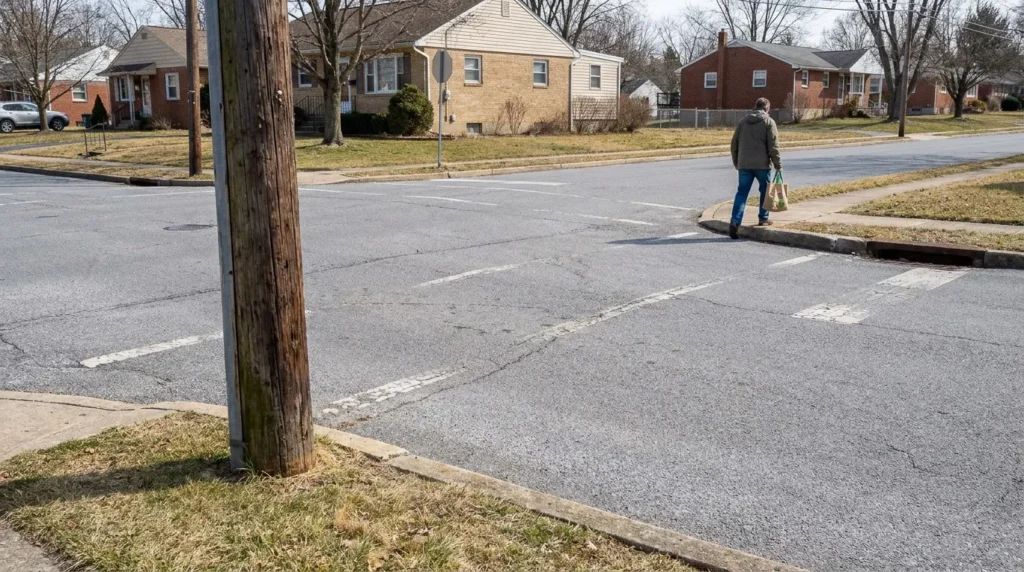
An unmarked crosswalk is a legally recognized pedestrian crossing that may exist at an intersection even without white lines, paint, or signage. Under Pennsylvania law, the crosswalk is defined by the intersection’s geometry, the extension of sidewalk or curb lines across the roadway. Many assume no paint means no protection, but that assumption is mistaken and can cost injured pedestrians when insurers use it to shift blame.
If you or a loved one were struck while crossing at an intersection without painted lines, The Injury Pros can review the facts and explain how Pennsylvania’s right-of-way rules apply. Call 215-642-2335 or contact us now to discuss what happened.
How the PA Vehicle Code Defines a Crosswalk
Pennsylvania’s crosswalk rules live in Title 75, the Vehicle Code. Title 75, Chapter 1, § 102 (Definitions) supplies the statutory meaning of "crosswalk," covering more than painted markings. The definition extends to the natural continuation of sidewalk, curb, and property lines at an intersection, as well as any portion of roadway distinctly indicated for crossing.
The statutory text confirms that crosswalks may exist whether or not they are painted. Under 75 Pa.C.S. § 3323(b), a driver approaching a stop sign shall stop at a clearly marked stop line or, if no stop line is present, before entering a crosswalk on the near side of the intersection or, if no crosswalk is present, then at the point nearest the intersecting roadway where the driver has a clear view of approaching traffic on the intersecting roadway before entering. That "if no crosswalk is present" language shows the legislature contemplated intersections both with and without visible markings. Section 3323(c) uses similar but not identical language for yield signs, requiring drivers to slow down and, if necessary for safety, stop before a crosswalk on the near side of the intersection or, if none, at the nearest point where the driver has a view of approaching traffic, and unlike § 3323(b), it does not include a clearly marked stop line as a stopping reference point.
These stopping rules operate within a traffic-control framework. Under 75 Pa.C.S. § 3323(a), preferential right-of-way at an intersection "may be indicated by stop signs or yield signs as authorized in section 6124." The crosswalk functions as the legal stopping boundary, and drivers who roll past that line into a crossing area may violate the Pennsylvania stop and yield sign statute.
Understanding the Unmarked Crosswalk Pennsylvania Right of Way Rule
Section 3542 of the Vehicle Code governs pedestrian right-of-way and treats marked and unmarked crossings alike. Under 75 Pa.C.S. § 3542(a), "When traffic-control signals are not in place or not in operation, the driver of a vehicle shall yield the right-of-way to a pedestrian crossing the roadway within any marked crosswalk or within any unmarked crosswalk at an intersection." This is the heart of the unmarked crosswalk Pennsylvania right of way rule, placing the duty to yield on the motorist.
The duty applies broadly at unsignalized intersections. Drivers must generally slow or stop wherever a person is lawfully crossing. This reinforces that intersections generally contain crosswalks, marked or not, unless crossing is otherwise restricted. PennDOT’s guidance confirms Pennsylvania law requires motorists to yield to pedestrians in crosswalks at both signalized and non-signalized intersections.
Enforcement exists, though the statutory penalty is modest. Under 75 Pa.C.S. § 3542(e), a driver who violates subsection (a) "commits a summary offense and shall, upon conviction, be sentenced to pay a fine of $50." A citation differs from civil liability, but evidence of a traffic violation may be relevant in a personal injury claim.
Marked vs Unmarked Crosswalk: A Practical Comparison
| Feature | Marked Crosswalk | Unmarked Crosswalk |
|---|---|---|
| Painted lines or signage | Present | Absent |
| Location | Intersections or mid-block | Generally at intersections only |
| Driver duty under § 3542(a) | Yield when signals are absent or inoperative | Yield when signals are absent or inoperative |
| Common insurance argument | Pedestrian entered suddenly | "There was no crosswalk there" |
| Proof challenges | Usually lower | Often requires scene documentation |
Where the Right-of-Way Rule Stops Applying
Pennsylvania pedestrian law does not give pedestrians unlimited priority. Under 75 Pa.C.S. § 3542(d), "Subsection (a) does not apply under the conditions stated in section 3543(b)." Section 3543(b) addresses locations where a pedestrian tunnel or overhead crossing has been provided, requiring pedestrians crossing the roadway to yield to all vehicles.
Crossings outside a crosswalk are treated differently. Under 75 Pa.C.S. § 3543(a), a pedestrian crossing at any point other than within a crosswalk must yield right-of-way to vehicles, and § 3543(c) requires pedestrians crossing between adjacent intersections in urban districts at which traffic-control signals are in operation to cross only in a marked crosswalk. A pedestrian’s failure to yield doesn’t automatically defeat an injury claim because Pennsylvania applies modified comparative negligence under 42 Pa.C.S. § 7102, which reduces recovery by the pedestrian’s fault share and bars recovery only if that share exceeds 50%.
Pedestrians carry duties even inside a crosswalk. Section 3542(b) provides that "No pedestrian shall suddenly leave a curb or other place of safety and walk or run into the path of a vehicle which is so close as to constitute a hazard." A pedestrian should give an approaching driver reasonable time to see the crossing and yield. Whether an entry was "sudden" depends on speed, sightlines, lighting, and witness accounts. Under 75 Pa.C.S. § 3542(c), drivers approaching from the rear are prohibited from overtaking and passing a vehicle that has stopped at a crosswalk to permit a pedestrian to cross.
💡 Pro Tip: If you can safely do so after a crash, photograph the intersection from the driver’s approach angle. Curb lines, sidewalk endpoints, and utility poles can help establish where the implied crosswalk in PA sat, even months later.
Why Unmarked Crosswalk Cases Get Contested
Insurance carriers frequently argue that a pedestrian was "jaywalking" when no paint was visible. That argument may misstate the PA crosswalk definition, but it can be persuasive without solid evidence. Building a record that establishes the crossing occurred within the intersection’s implied crosswalk is often central to these claims.
Evidence That Often Matters
- Scene photographs showing sidewalk and curb line alignment
- Police crash reports and any citation issued
- Independent witness statements about where the pedestrian entered the roadway
- Vehicle damage patterns and final positions
- Nearby business or traffic camera footage, often overwritten within days
- Cell phone records, when driver inattention is suspected
Driver distraction is a recurring theme in intersection crossing PA cases. A motorist looking at a phone may never register a person stepping off the curb. Understanding PA’s hands-free law and crash claims can help injured pedestrians see how multiple statutory violations may interact within a single case.
💡 Pro Tip: Request the full police crash report rather than relying on a summary. Diagrams and officer narratives sometimes describe the point of impact in ways that may support an unmarked crosswalk position.
Practical Steps After an Unmarked Crosswalk Collision
Prompt medical evaluation protects both health and the evidentiary record. Pedestrian injuries often include internal trauma or head injuries not obvious at the scene, and treatment delays may give insurers room to argue injuries came from something else. Follow the treatment plan and keep every record.
Preserve evidence quickly, because it may disappear. Video is routinely overwritten, skid marks fade, and witness memories blur. Written notes made the same day describing where you stepped off the curb, which direction you walked, and where the vehicle was when you first saw it can be valuable later.
Be cautious with recorded statements. Adjusters may ask questions framed around whether a crosswalk was "there," which invites an answer that could contradict the pedestrian right-of-way statute. You are generally not required to give a recorded statement to another driver’s insurer before understanding your rights. Speaking with an unmarked crosswalk Pennsylvania right of way lawyer before that conversation may help avoid unnecessary complications.
Frequently Asked Questions
1. Does an unmarked crosswalk exist at every intersection?
Generally, an unmarked crosswalk is recognized where sidewalk, curb, or property lines extend across the roadway at an intersection, subject to definitions in 75 Pa.C.S. § 102. Some locations, such as those with barriers, alley or driveway junctions, or places where crossing is prohibited by ordinance, may present exceptions.
2. Do drivers have to yield if there is no painted crosswalk?
Under 75 Pa.C.S. § 3542(a), drivers must yield to pedestrians in unmarked crosswalks at intersections when traffic-control signals are not in place or not in operation. Where a signal is operating, pedestrian-control signal rules govern. The absence of paint does not eliminate the duty to yield, and drivers still owe a general duty of care toward pedestrians under Pennsylvania law.
3. Can I still recover if I was partly at fault?
Pennsylvania follows modified comparative negligence, so a pedestrian’s conduct reduces recovery in proportion to fault and bars recovery only if the pedestrian’s fault exceeds 50%. Courts may consider whether the pedestrian suddenly left a curb under § 3542(b) or crossed outside a crosswalk under § 3543. Outcomes depend on specific facts and available evidence.
4. What is the penalty for a driver who fails to yield?
Section 3542(e) provides that a violation of subsection (a) is a summary offense carrying a $50 fine upon conviction, plus applicable court costs and surcharges. That penalty is separate from any civil claim for damages.
5. How long do I have to file a pedestrian injury claim in Pennsylvania?
Most Pennsylvania personal injury actions are subject to a two-year statute of limitations under 42 Pa.C.S. § 5524, and claims against government entities generally require written notice within six months under 42 Pa.C.S. § 5522. Confirming your specific dates early is important.
What This Means for Injured Pedestrians
Crosswalk law in PA does not depend on paint. Section 3542 extends the same right-of-way protection to unmarked crossings at intersections that it gives to marked ones, and §§ 3323(b) and (c) indicate the Vehicle Code treats crosswalks as existing even where no markings appear. The protection has limits under § 3542(d) and § 3543, pedestrians carry their own duties under § 3542(b), and every case turns on its particular facts. Reviewing the state’s pedestrian safety information can help, but statutes alone rarely resolve a disputed claim.
If a driver failed to yield at an intersection near you, the team at The Injury Pros is ready to listen and evaluate your options. Call 215-642-2335 or reach out today to get started.
Disclaimer: This content is for informational purposes only and is not legal advice. Every case is unique, and results may vary. Consult an attorney about your specific circumstances.