
Key Takeaways: Pennsylvania’s six-month notice rule under 42 Pa.C.S. § 5522 requires anyone injured on a government-owned sidewalk to serve written notice within six months of the injury. The notice must identify the injured person’s name and residence, the date, hour, and location of the accident, and any treating physician. This is separate from the two-year personal injury statute of limitations under 42 Pa.C.S. § 5524, and both deadlines run simultaneously. Claims against local governments arise under the Political Subdivision Tort Claims Act, while state property claims follow a separate administrative process. Even with timely notice, liability depends on proving duty, dangerous condition, notice, and causation, with comparative negligence and statutory damage caps potentially limiting recovery.
If you tripped on a broken government-owned sidewalk in Pennsylvania, you generally have only six months to give written notice of your claim, despite the two-year statute of limitations. That short window comes from 42 Pa.C.S. § 5522. Miss it, and your case may be barred before reaching court, unless a statutory exception applies.
The Injury Pros helps injured Pennsylvanians act before short deadlines close the door on recovery. If you were hurt on a cracked or poorly maintained public walkway, call 215-642-2335 or contact us now to discuss your options with The Injury Pros.
What 42 Pa.C.S. § 5522 Actually Requires
The statute imposes a written notice requirement separate from, and much shorter than, the lawsuit filing deadline. Under 42 Pa.C.S. § 5522(a), any person intending to bring a claim against a government unit for injuries must, within six months of the injury date, provide written notice describing the incident. The notice must identify the injured person’s name and residence, the accident date and hour, location, and treating physician’s name and address. One tolling provision states that the notice period does not include time during which the injured individual is unable, due to incapacitation or disability from the injury itself, to give notice — and this exception is capped at a maximum of 90 days. The statute also provides that if injuries result in death, the notice period commences with the death, and that failure to comply is not a bar if the government unit had actual or constructive notice of the incident or condition.
This is treated as a procedural condition courts rarely excuse. Pennsylvania courts recognize limited circumstances where noncompliance may be excused, including reasonable excuse for the failure, but exceptions are narrowly interpreted. Some courts consider whether the government was actually prejudiced by delay, but claimants should not assume substantial compliance or actual knowledge will satisfy the statute.
The policy rationale is investigative. Notice-of-claim statutes allow government agencies to promptly investigate alleged defects while evidence exists. Sidewalk defects exemplify this, since a pothole or heaved slab may be repaired within weeks of a fall.

Why the pa 5522 six-month notice sidewalk fall Rule Exists
Sidewalk defects are among the most commonly repaired hazards in many cities. Notice deadlines for street and sidewalk conditions reflect a long-recognized tradition of tight windows for injuries caused by public walkway defects in Pennsylvania.
Courts have not universally agreed these short deadlines are fair. Some jurisdictions have struck down short notice periods as unreasonable, while others uphold them as reasonable legislative choices. Pennsylvania’s rule remains in force, so the practical takeaway is simple: assume the deadline applies and act accordingly.
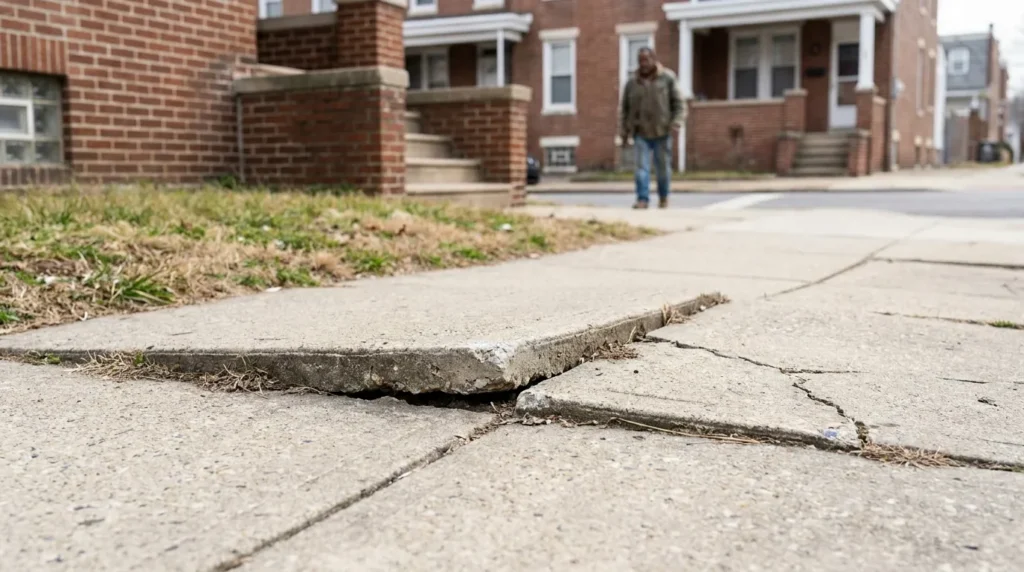
💡 Pro Tip: Photograph the defect from multiple angles the same day if possible, including a measurement reference such as a coin or ruler next to the height differential. Repairs can erase evidence long before your claim is evaluated.
Sovereign Immunity, Local Agencies, and Why Notice Is Only Step One
Pennsylvania governments are generally immune from suit unless a statute says otherwise. The Political Subdivision Tort Claims Act governs municipal liability and waives immunity only in enumerated instances of negligence. Sidewalk claims can fall within a recognized exception, but the claim must satisfy every statutory prerequisite, and damages are generally capped at $500,000 in the aggregate.
Claims Against a City, Township, or Borough
Local agency claims arise under the Political Subdivision Tort Claims Act, 42 Pa.C.S. §§ 8541-8542. Sidewalk cases frequently turn on whether the defect qualifies under the sidewalk or real property exception, whether injury was reasonably foreseeable, and whether the agency had actual or constructive notice of the dangerous condition in time to take corrective action. The sidewalk exception can shift primary responsibility to the abutting property owner where local law imposes a maintenance duty.
Claims Against the Commonwealth
If the walkway sits on state property, a different agency and process apply. Commonwealth sovereign immunity is waived only in limited categories under 42 Pa.C.S. § 8522, such as a dangerous condition of Commonwealth agency real estate and sidewalks (§ 8522(b)(4)), or the care, custody, or control of personal property in the possession or control of Commonwealth parties (§ 8522(b)(3)). The Department of General Services explains the process to file a claim against the Commonwealth, noting claimants generally have six months from the incident date to present the claim per 42 Pa.C.S. § 5522. Damages recoverable against the Commonwealth are also statutorily capped.
Intentional Conduct Is Generally Outside the Waiver
Pennsylvania’s tort claims framework abrogates immunity only for enumerated negligence instances and typically excludes intentional torts. Individual employees may lose immunity for willful misconduct. Sidewalk fall claims are generally pleaded as negligence, requiring proof of duty, breach, causation, and measurable damages.
How a Sidewalk Fall Claim Is Actually Submitted
Most Pennsylvania municipalities require written claims on official forms submitted to the city’s law department or risk office. For example, the City of Pittsburgh instructs claimants to complete a Report of Claim Form and submit it to the Law Department, publishing downloadable resources including claim forms and FAQs.
Commonwealth claims follow their own administrative track. The Bureau of Finance and Risk Management (FARM) investigates and adjudicates third-party claims involving Commonwealth employees, vehicles, or property. Incidents must be documented with time, date, location, and damage extent, then submitted through FARM’s claims portal.
These administrative submissions are not lawsuits. Filing a claim form with a city or state bureau does not toll or replace the two-year civil statute of limitations for personal injury under 42 Pa.C.S. § 5524, nor does a local form automatically satisfy § 5522’s content requirements. Treat the administrative process and civil deadline as separate clocks running simultaneously.
| Deadline | Authority | What It Governs |
|---|---|---|
| 6 months from injury | 42 Pa.C.S. § 5522 | Written notice to the government unit |
| 2 years from injury | 42 Pa.C.S. § 5524 | Filing the civil personal injury lawsuit |
| Varies by agency | Local ordinance or agency policy | Administrative claim form submission |
Building the Negligence Case Behind the Notice
Meeting the deadline preserves the claim, but liability still depends on proving negligence. Municipal sidewalk injury cases require proving the entity owed a duty to maintain the walkway, a dangerous condition existed, the entity had actual or constructive notice of that condition, and the defect caused your injuries. Constructive notice often becomes central, asking whether the hazard existed long enough that a reasonably careful entity should have discovered and repaired it.
Evidence that matters in these cases includes:
- Dated photographs and video of the defect and surrounding area
- Prior complaints, 311 reports, or work orders regarding the same location
- Witness statements from neighbors, business owners, or passersby
- Medical records tying injuries to the fall date and mechanism
- Measurements showing height differential or gap width
Comparative negligence may also apply. Under 42 Pa.C.S. § 7102, recovery may be reduced proportionally to your share of fault and barred entirely if your fault exceeds the defendants’ combined fault. Courts may consider lighting, footwear, distraction, and whether the hazard was open and obvious.
When Deadlines Are Extended, and Why You Should Not Count On It
Pennsylvania law recognizes limited tolling and excuse doctrines, construed narrowly. Section 5522 contemplates that failure to give timely notice may be excused where a claimant shows reasonable excuse, and separate provisions, including 42 Pa.C.S. § 5533, address minority and incapacity for limitations purposes. Application is fact-specific.
The discovery rule is likewise narrow in this context. It may operate only where an injured person, exercising reasonable diligence, could not have known of the injury and its cause, uncommon in a trip and fall PA scenario where the fall and defect are immediately apparent. Different deadlines may apply in other injury contexts, which is why readers researching the statute of limitations for car accidents in PA are surprised government claims move on a faster schedule.
💡 Pro Tip: Send notice by a method creating proof of delivery, and keep copies of everything. If unsure which entity owns the sidewalk, serve notice on every plausible government unit rather than guessing.
Frequently Asked Questions
1. Does the six-month notice rule replace the two-year statute of limitations?
No. The written notice requirement under 42 Pa.C.S. § 5522 is typically an additional prerequisite. You must give notice within six months and still file suit within the applicable limitations period, subject to exceptions.
2. What if the sidewalk is next to a private business but owned by the city?
Ownership, control, and maintenance responsibility can be split among a municipality, abutting landowner, and sometimes a utility. Pennsylvania law may place primary responsibility on the abutting owner in certain circumstances. It is often prudent to preserve claims against each potentially responsible party.
3. Is there a standard form for a notice to municipality in Pennsylvania?
The statute specifies required content rather than a universal form, but many municipalities publish their own claim forms and submission instructions. Using the local form does not excuse you from including every statutory element.
4. What happens if I miss the six-month deadline?
Late notice may result in dismissal, though the statute allows courts to excuse noncompliance where reasonable excuse is shown, and some courts weigh whether the government was prejudiced. Outcomes depend heavily on specific facts and are never guaranteed.
5. Do I need a lawyer to file a government sidewalk claim?
You are not required to have counsel, but these claims involve overlapping immunity rules, notice content requirements, damage caps, and short deadlines. A pa 5522 six-month notice sidewalk fall lawyer can evaluate which entity may be responsible and how deadlines apply to your situation.
The Bottom Line on Pennsylvania’s Government Notice Deadline
A sidewalk fall claim against a Pennsylvania government unit depends heavily on early action. The PA six-month notice requirement under 42 Pa.C.S. § 5522, layered on top of narrow immunity waivers under the Political Subdivision Tort Claims Act and 42 Pa.C.S. § 8522, means a strong premises liability Pennsylvania case may be lost on procedure alone. Identifying the correct government unit, serving statutorily sufficient written notice, and preserving defect evidence are practical steps that may keep the claim alive.
Every case turns on its own facts, and nothing here should be treated as individualized legal advice. If your injury happened on a public walkway, the safest assumption is that a Pennsylvania injury deadline may already be running. Reach out to The Injury Pros team by calling 215-642-2335 or schedule a case review so your notice obligations can be evaluated promptly.
Disclaimer: This content is for informational purposes only and is not legal advice. Every case is unique, and results may vary. Consult an attorney about your specific circumstances.