
When a Truck’s Load Breaks Loose: Understanding Tiedown Strength Standards in Pennsylvania
Key Takeaways: The 50 percent working load limit rule is a federal cargo securement standard under 49 C.F.R. § 393.106(d) requiring that the aggregate working load limit of the tiedowns used to secure cargo be at least one-half its weight. A 20,000-pound load generally calls for tiedowns with an aggregate working load limit of at least 10,000 pounds, though not every device contributes its full rating. Pennsylvania incorporates the federal cargo securement rules into state law for intrastate operations through 67 Pa. Code Chapter 231, so intrastate carriers generally cannot argue the rules don’t apply. Meeting the 50 percent floor doesn’t guarantee compliance, since commodity-specific rules and minimum tiedown requirements may also apply. Proving a violation often depends on evidence that can disappear fast, including bills of lading, weight tickets, tiedown hardware, inspection records, and electronic data. Responsibility may extend beyond the driver to the motor carrier, shipper, loading contractor, equipment supplier, or maintenance provider.
The 50 percent working load limit rule requires that the combined strength rating of the tiedowns holding a load be at least half the weight of that load. Under 49 C.F.R. § 393.106(d), the aggregate working load limit of the tiedowns securing cargo must be at least one-half its weight, subject to exceptions and commodity-specific provisions elsewhere in Subpart I. In a Pennsylvania truck crash case, this requirement can become the pivot point of liability, converting a vague question about whether a load was "secured well enough" into a measurable problem investigators, engineers, and juries can evaluate.
If a shifting or falling load injured you or someone you love, the team at The Injury Pros can help you preserve the bills of lading, inspection reports, and tiedown hardware that often decide these claims. Call 215-642-2335 or reach out to our team now to discuss what happened.
How the 50 Percent Aggregate Working Load Limit Actually Works
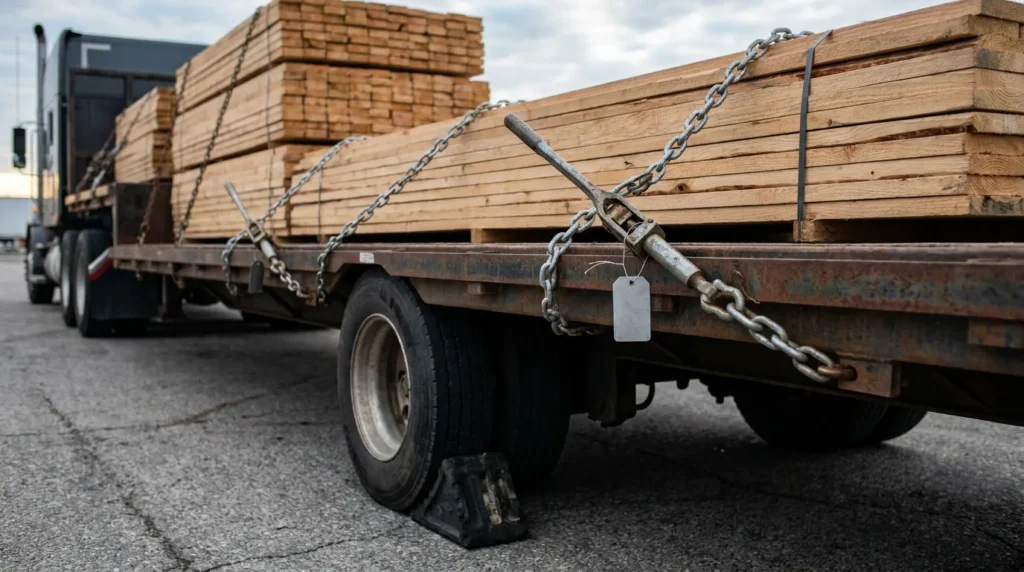
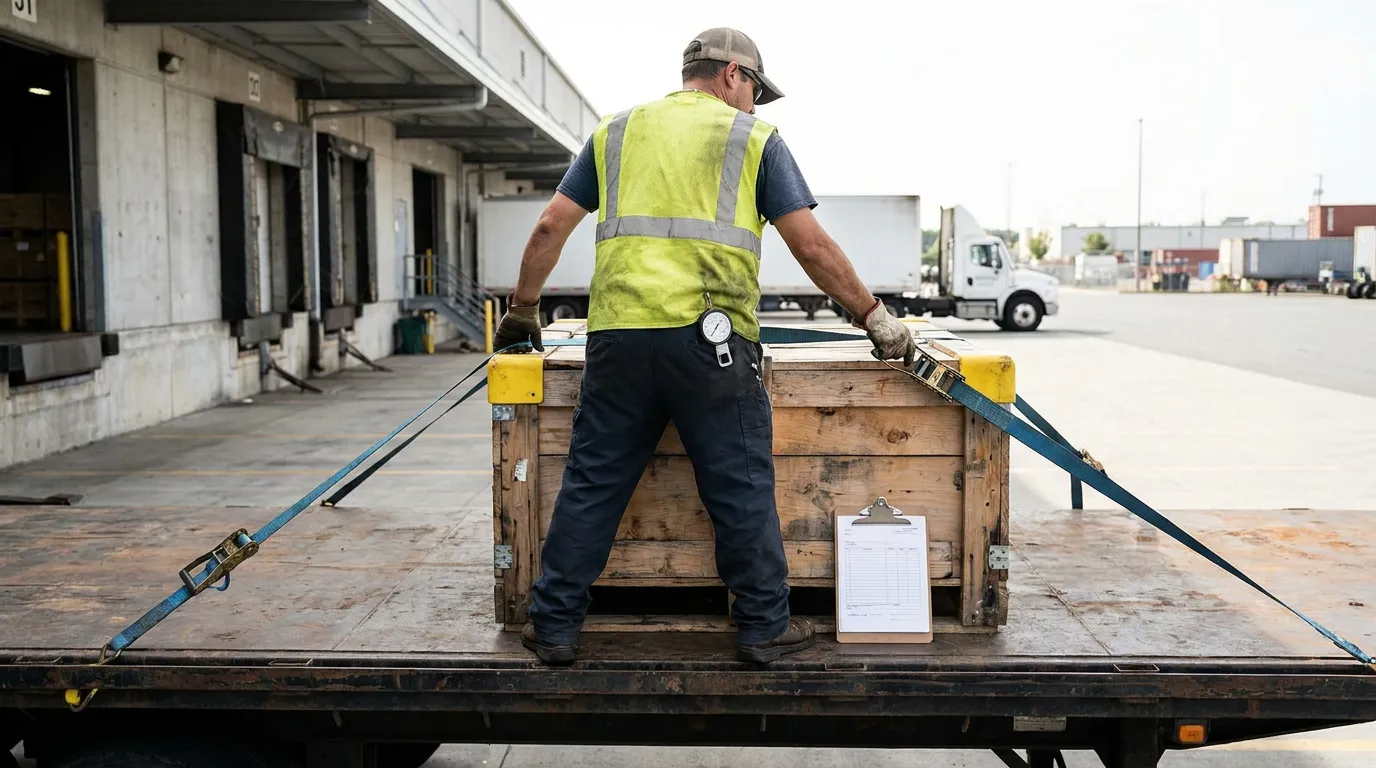
Every tiedown, chain, strap, and binder generally carries a manufacturer-assigned working load limit stamped or tagged onto the device, reflecting the load it’s designed to carry in normal service, not the point at which it breaks. Federal rules address how the limit is determined when a device is unmarked, and treat the weakest component of a tiedown assembly, including anchor points, as limiting the assembly’s rating. An investigator adds the working load limit values of each securement device and compares that total to the cargo’s weight.
The math is straightforward, but application is where disputes begin. A 20,000-pound steel coil generally requires tiedowns with an aggregate working load limit of at least 10,000 pounds. Not every device contributes its full rating: a tiedown running from the vehicle to a cargo attachment point typically counts at only half its rating, while one that passes over or through the cargo and anchors on both sides may count at its full rating.
Federal rules also layer commodity-specific requirements on top of the general standard. The FMCSA cargo securement rules set separate provisions for logs, metal coils, paper rolls, concrete pipe, intermodal containers, automobiles, heavy equipment, flattened vehicles, roll-on containers, and large boulders. Meeting the 50 percent threshold doesn’t necessarily satisfy those additional rules; a carrier may comply with one while violating another.
Why This Rule Exists
The modern cargo securement framework grew out of a multi-year effort to harmonize standards across the U.S., Canada, and Mexico, producing the performance-based rules codified in 49 C.F.R. Part 393, Subpart I.
The rationale is physics. Cargo in a moving trailer carries momentum, and hard braking, evasive steering, or a curve taken at speed generates forces a marginal securement system may not restrain. The 50 percent figure is a regulatory minimum keyed to assumed deceleration and acceleration forces, and a system barely satisfying it may still fall short of other performance requirements in the same rules.
Pennsylvania’s Adoption of Federal Securement Standards
Pennsylvania doesn’t write its own comprehensive cargo securement code. Instead, its Intrastate Motor Carrier Safety Requirements at 67 Pa. Code Chapter 231 adopt portions of 49 C.F.R. by reference, including Part 393’s cargo securement provisions, subject to definitions and modifications in that chapter. Narrower state provisions also exist for particular commodities; 67 Pa. Code § 181.5, for example, governs loading and securement of junked vehicles and hulks.
This structure matters for a Pennsylvania truck crash claim because it may close a common defense argument: a carrier hauling exclusively within Pennsylvania generally cannot plausibly claim federal securement rules are irrelevant to its route. Interstate carriers are bound directly by federal regulation; intrastate carriers are generally bound through the Commonwealth’s incorporation of those standards.
Enforcement on the ground falls largely to the Pennsylvania State Police, which conducts commercial vehicle inspections and enforces motor carrier safety regulations statewide alongside PennDOT and certified local officers. Inspection reports and out-of-service orders generated through that enforcement frequently become foundational documents in litigation, though admissibility and evidentiary weight are decided case by case.
Proving Cargo Securement Violations Truck Accident Claims Depend On
Establishing a securement failure often requires evidence that can begin disappearing within hours of a crash. Straps may be cut by rescue crews, cargo reloaded onto a replacement trailer, and the tractor returned to service. An advocate-oriented investigation generally moves quickly to lock down the physical and documentary record before the scene evaporates.
The proof typically assembled in these cases includes:
- Bills of lading, weight tickets, and shipping manifests establishing actual cargo weight
- Photographs and physical preservation of straps, chains, binders, and anchor points
- Driver vehicle inspection reports and pre-trip inspection records
- Loading dock video, seal records, and third-party loader documentation
- Roadside inspection history and prior violation records for the carrier
- Electronic logging device and event data recorder downloads showing speed and braking
A preservation letter sent early can make the difference between a provable case and a swearing contest. Federal recordkeeping rules require carriers to retain many records only for limited periods, and some electronic data may be overwritten on short cycles. Counsel handling a truck cargo shift lawsuit will often send spoliation notices to the motor carrier, shipper, and any loading contractor within days of being retained, and Pennsylvania courts may impose sanctions for destroying evidence once a party is on notice of potential litigation.
💡 Pro Tip: Photograph the tiedown tags if you can safely do so. The working load limit is usually printed on a small label sewn into a strap or stamped into a chain link, typically the starting point for the entire calculation.
The Role of Negligence Per Se
Pennsylvania courts may treat violation of a safety statute or regulation as negligence per se when the plaintiff falls within the class the rule was meant to protect and the harm is the type the rule was meant to prevent. Cargo securement rules exist to protect the motoring public from shifting and falling loads, potentially placing many injured travelers within the protected class. Even where the doctrine applies, it establishes only breach of duty; the plaintiff must still prove causation and damages.
Negligence per se has real limits, and courts apply it carefully. A defendant may contest whether a violation occurred, whether it caused the collision, or whether an intervening factor broke the causal chain. Some Pennsylvania decisions have declined to apply the doctrine to particular regulations, treating a violation instead as evidence of negligence. Outcomes remain fact-dependent.
Who May Be Responsible for Load Securement Negligence
The driver is rarely the only potential defendant in a securement case. Federal rules place responsibility on the motor carrier and its drivers, but the practical chain of custody over a load may also include parties who never appear on the police report. Claims against non-carrier parties generally rest on ordinary negligence or product liability principles rather than the federal regulations themselves.
| Potential Defendant | Typical Basis for Liability |
|---|---|
| Truck driver | Failure to inspect or re-check securement en route |
| Motor carrier | Inadequate training, supervision, or equipment provision |
| Shipper or loading contractor | Improper loading, blocking, or bracing of cargo |
| Equipment supplier | Defective or degraded straps, chains, or binders |
| Maintenance contractor | Failure to identify damaged anchor points or rub rails |
The sealed-load defense deserves particular attention. Carriers sometimes argue a sealed trailer prevented the driver from inspecting the cargo, and federal rules do relieve a driver of the inspection duty where the vehicle is sealed or the driver is ordered not to open it. That allowance addresses only the driver’s inspection obligation; it doesn’t excuse the carrier’s underlying duty to secure the load under Part 393. Whether the defense helps a defendant depends on whether the load was genuinely sealed, whether the driver had any practical opportunity to inspect, and whether the failure involved tiedowns visible from outside the trailer.
Common Obstacles in a Pennsylvania Truck Crash Claim
Defense counsel often concede that cargo shifted while disputing that a regulatory violation caused it, frequently arguing a road hazard or another motorist’s maneuver forced an emergency braking event beyond what any compliant system could withstand. Countering that argument generally requires reconstruction analysis and testimony addressing the forces the system should have withstood.
Another recurring obstacle involves cargo weight itself. Working load limit calculations depend on knowing what the load actually weighed, and shipping paperwork sometimes understates or misstates weight. Scale tickets, tare weights, and post-crash weighing of recovered cargo may all become relevant. Our truck accident practice approaches these disputes by documenting the weight question early rather than accepting the carrier’s figures.
Comparative fault is also raised with regularity. Pennsylvania follows a modified comparative negligence rule under which a plaintiff whose fault exceeds 50 percent recovers nothing, and any award is otherwise reduced proportionally. A defense may try to assign fault to the injured motorist’s following distance, speed, or reaction. These allocations are fact-intensive and can materially affect recovery.
Where Crash Causation Research Fits
Federal crash causation research provides useful background without resolving individual cases. The joint FMCSA and NHTSA Large Truck Crash Causation Study examined driver, vehicle, and environmental factors associated with serious large truck collisions nationwide. That study reported associated factors rather than legal fault and didn’t focus on tiedown strength rules, so it functions as context rather than authority on the 50 percent standard.
Treating statistical research as proof of a particular securement failure would be a mistake. Courts generally require evidence tied to the specific vehicle, load, and securement system involved. General data may help a jury understand why these rules exist, but it’s unlikely to substitute for the hardware, paperwork, and calculations in your case.
💡 Pro Tip: Request the carrier’s roadside inspection history through public FMCSA data early. A pattern of prior securement citations may support arguments about notice and corporate safety practices.
Frequently Asked Questions
1. Does the 50 percent rule apply if the truck never left Pennsylvania?
Generally yes. Pennsylvania’s intrastate motor carrier safety regulations adopt 49 C.F.R. Part 393 by reference, bringing the cargo securement provisions of Subpart I into state law for covered intrastate operations. Certain exemptions and state-specific modifications may apply depending on vehicle type, weight, and operation.
2. What if the tiedowns met the 50 percent threshold but the cargo still shifted?
Compliance with the aggregate working load limit doesn’t end the analysis. Federal rules also impose a minimum number of tiedowns based on cargo length and weight, commodity-specific requirements, and general performance criteria. A load may meet the 50 percent floor while violating other provisions.
3. Can I bring a claim against the company that loaded the trailer rather than the trucking company?
Under certain circumstances, yes. When a shipper or third-party loading contractor performed the loading, blocking, and bracing, that entity may share responsibility for an improper tiedown injury under ordinary negligence principles. Identifying every potentially responsible party requires reviewing loading records, contracts, and dock procedures.
4. How quickly do I need to act to preserve securement evidence?
As soon as practical. Straps, chains, and damaged anchor hardware are routinely discarded or returned to service, and electronic data may be overwritten quickly. Early preservation demands help protect the record, though no effort can guarantee every item survives. Pennsylvania’s statute of limitations for most personal injury claims is two years, with different deadlines for some claims, including those against government entities.
5. Does a citation for a securement violation mean the case is won?
No. A citation may support a negligence argument, but Pennsylvania courts still generally require proof that the violation caused the collision and resulting harm, and the citation itself may not be admissible in the civil case. Defendants may dispute causation, contest the violation itself, or raise comparative fault.
Bringing the Numbers and the Law Together
Cargo securement violations truck accident cases turn on details that are easy to overlook and hard to recreate after the fact. The 50 percent aggregate working load limit may give injured Pennsylvanians a concrete, measurable standard grounded in federal regulation and incorporated into state law. Proving a breach, however, generally requires disciplined evidence preservation, accurate weight documentation, and careful analysis of who controlled the load at each stage.
No two crashes present identical facts, and outcomes depend on the evidence available in each situation. Readers wanting a broader view of trucking liability issues may find additional discussion of commercial trucking regulations in PA across our published articles. Nothing here substitutes for advice tailored to your circumstances.
If shifting or falling cargo caused serious injury or the loss of a family member, The Injury Pros is prepared to investigate the securement system, the loading chain, and the carrier’s safety record. Call 215-642-2335 or schedule your consultation today to learn more about your options.
Disclaimer: This content is for informational purposes only and is not legal advice. Every case is unique, and results may vary. Consult an attorney about your specific circumstances.