
Why Proving the Property Owner "Should Have Known" Can Decide Your Case
Key Takeaways: Constructive notice means a Pennsylvania property owner may be held liable for a hazard it never actually knew about, if the condition existed long enough that reasonable inspection would likely have uncovered and corrected it. Injured business invitees generally must show the owner created the hazard, had actual notice of it, or had constructive notice, and that third path is often where insurers concentrate their defense. Pennsylvania law sets no fixed time threshold, so courts may weigh the type of hazard, the nature of the business, foot traffic, inspection policies, and the physical appearance of the condition. Sweep logs, maintenance records, surveillance footage, and witness accounts often influence these disputes, but video is frequently overwritten within days. Recurring hazards such as wet floors, uneven pavement, poor lighting, torn carpeting, and defective stair treads may raise notice questions because they are often discoverable through ordinary inspection. Prompt reporting, documentation, medical care, and attention to Pennsylvania’s two-year filing deadline can improve an injured person’s chance of proving the notice element.
Constructive notice is the legal principle that a property owner may be held responsible for a dangerous condition it did not actually know about, provided the hazard existed long enough that a reasonably careful owner would likely have discovered and corrected it through ordinary inspection. In Pennsylvania premises liability claims brought by business invitees, an injured visitor generally must prove the owner had actual knowledge of the hazard or should have known about it. That second path is constructive notice, and in slip-and-fall cases it is frequently the element insurance companies contest most heavily.
If you were hurt on someone else’s property in Philadelphia or a surrounding county, the team at The Injury Pros can help you evaluate whether the evidence supports the notice element of your claim. Call 215-642-2335 to discuss what happened, or contact us now to request a case review.
The Notice Element in Pennsylvania Negligence Law
Pennsylvania negligence law generally requires an injured plaintiff to prove duty, breach, causation, and damages, and in premises cases the notice requirement often shapes the breach analysis. The duty owed depends on the visitor’s status as an invitee, licensee, or trespasser. A landowner generally owes the highest duty to business invitees, including a duty to inspect and discover dangerous conditions; lesser duties are typically owed to licensees and trespassers. Property owners are generally not insurers of visitor safety, and liability typically depends on whether the owner knew or should have known about the specific hazard that caused the injury. Courts may also consider whether a condition was open and obvious, though that factor does not always defeat a claim where harm remains foreseeable.
Courts generally distinguish between three ways a plaintiff may satisfy the notice element. First, the owner or its employees created the condition. Second, the owner had actual notice, meaning someone reported or observed the hazard. Third, the owner had constructive notice because the condition persisted long enough for reasonable inspection to reveal it. Which theory applies depends heavily on the facts, and more than one may be available in a single case.
💡 Pro Tip: Photograph the hazard immediately, including any dirt, tracking, footprints, or drying edges in a spill. Those details can become important evidence that a condition had been present for a meaningful period of time.
How Courts Evaluate Constructive Notice Premises Liability Claims
Pennsylvania’s approach to constructive notice in premises liability traces back to a line of Supreme Court and Superior Court decisions from the early and mid-twentieth century that generally remain citable precedent unless later overruled or modified. The constructive notice framework requiring proof that a condition persisted long enough for a reasonably diligent owner to discover and remedy it is reflected in Pennsylvania appellate decisions and has been articulated in cases such as Swift v. Northeastern Hospital and related precedent. Later opinions, including the decision reported at 333 Pa. 584 (Pa. 1939), continued articulating the rule that liability generally attaches only where the owner had actual notice or where the hazard persisted long enough that reasonable inspection should have revealed it. Pennsylvania courts have since framed much of this analysis through Sections 343 and 343A of the Restatement (Second) of Torts.
There is no fixed number of minutes that establishes constructive notice under Pennsylvania law. Courts may consider the nature of the hazard, the character of the business, foot traffic volume, the owner’s inspection policies, and the physical appearance of the condition at the time of the fall. A puddle in a grocery aisle during a rainstorm may be analyzed differently than a cracked stair tread that deteriorated over months; snow and ice claims may also involve additional doctrines, such as the hills and ridges rule, that apply only in limited circumstances. Because the analysis is fact-dependent, outcomes vary significantly from case to case.
Time, Place, and the Nature of the Hazard
The longer a condition lasts and the more obvious it is, the stronger the constructive notice argument may become. Transitory hazards, such as a dropped jar of sauce, generally place a heavy burden on the injured person to show the spill sat unattended, and speculation about duration is typically not enough to reach a jury. Structural or maintenance-related defects may present a different picture. Worn flooring, broken handrails, burned-out lighting, and accumulated debris often develop gradually, which may support an argument that routine inspection should have caught the problem.
Inspection Records and Maintenance Policies
Internal documents can be significant to the hazard knowledge standard in litigation. Sweep logs, maintenance schedules, incident reports, work orders, and employee training materials may show how often an owner claimed to inspect and whether those inspections actually occurred. Safety organizations emphasize that regular inspection and prompt correction are core prevention strategies for slips, trips, and falls, and falls remain a leading cause of unintentional injury nationally. An internal policy does not itself set the legal standard of care, but when an owner’s own policy called for hourly checks and none was logged, that gap may support the plaintiff’s position.
Surveillance Footage and Witness Accounts
Video evidence can be among the most direct proof of how long a hazard existed, but it often disappears quickly. Many businesses overwrite footage within days or weeks. A prompt preservation letter may be necessary to prevent routine deletion, and where relevant evidence is destroyed after a duty to preserve arises, courts may consider spoliation sanctions. Witness statements from other customers, delivery drivers, or employees may also help establish a timeline when video is unavailable.
Common Hazards That Raise Constructive Notice Questions
Certain recurring conditions generate much of the premises liability PA claims involving notice disputes. These hazards share a common feature: they are often discoverable through ordinary inspection. Federal safety campaigns focused on preventing workplace falls reinforce that fall hazards are generally foreseeable and preventable when property managers proactively identify and address them, although OSHA standards govern workplace safety enforcement and do not themselves create a private right of action.
- Wet, oily, or contaminated floors, including tracked-in rain and snow
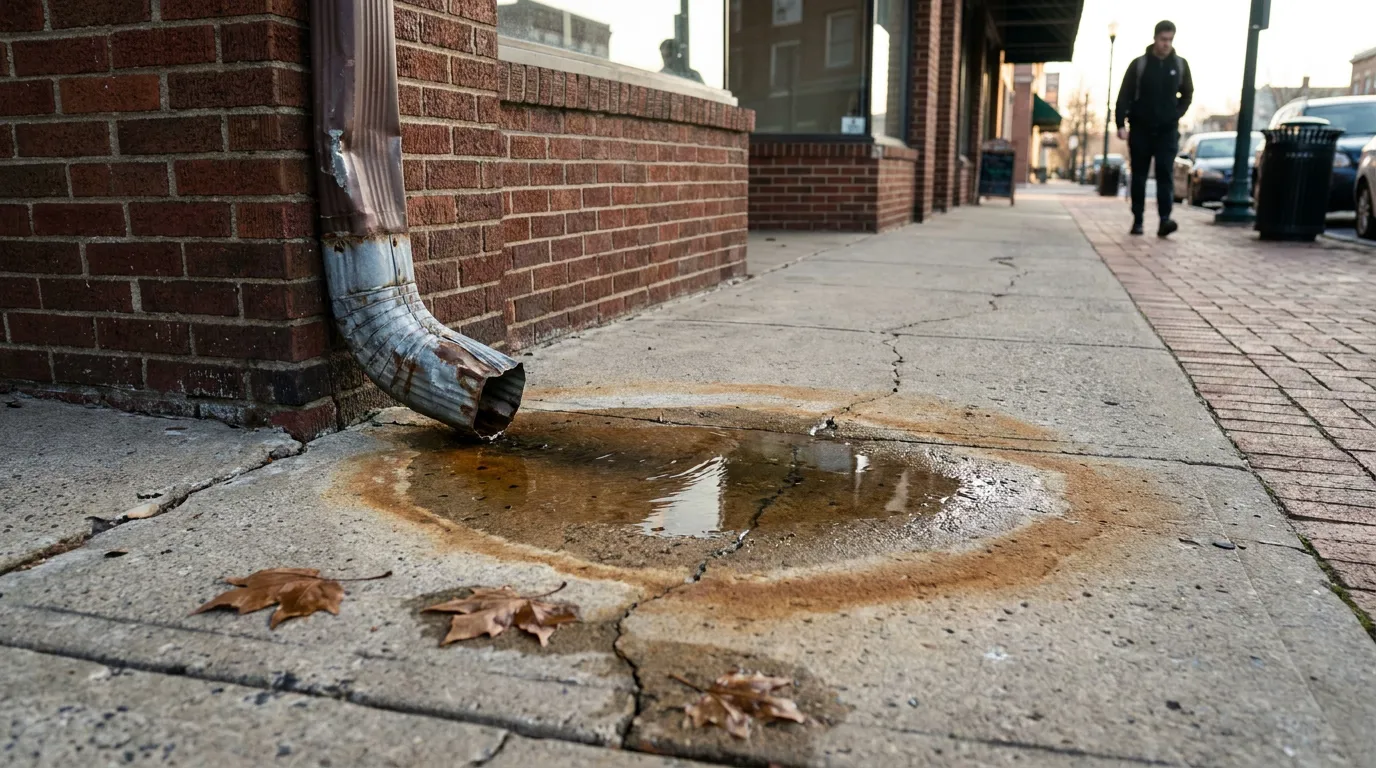
- Uneven walking surfaces, broken pavement, and raised sidewalk slabs
- Poor or failed lighting in stairwells, parking garages, and hallways
- Loose flooring, torn carpeting, and damaged thresholds
- Clutter, debris, and obstructed walkways
- Missing or unstable handrails and defective stair treads
| Type of Notice | What It Generally Requires | Typical Evidence |
|---|---|---|
| Owner created the hazard | Proof an employee or agent caused the condition | Employee testimony, video, work orders |
| Actual notice | Proof the owner knew of the specific condition | Complaint logs, prior incident reports, texts or emails |
| Constructive notice | Proof the condition lasted long enough to be discovered | Timestamped video, inspection logs, condition of the hazard |
Why Constructive Notice Matters Most in Slip and Fall Cases
Insurance carriers commonly concede that a hazard existed while denying that their insured had any opportunity to discover it. This is a common defense posture in Pennsylvania slip-and-fall claims, and it is one reason the notice element may receive disproportionate attention. Without evidence of duration or discoverability, a claim that otherwise looks strong may be dismissed on summary judgment.
Building safety obligations can also inform what a reasonable owner should have known. Pennsylvania maintains a state regulatory framework addressing building safety compliance, and local municipalities often enforce their own property maintenance and building codes. Regulatory or code compliance duties do not automatically create civil liability, and courts generally treat them as one consideration rather than a substitute for the common-law negligence analysis. Still, a documented failure to meet basic maintenance expectations may support an argument about reasonable care.
Falls can carry especially serious consequences for older adults, which may affect damages discussions. Seniors may face elevated risk of fracture and long-term functional loss from the same environmental hazards that cause minor injuries in younger visitors. That reality does not change the legal standard or the notice requirement, but it may increase the medical and financial stakes for the injured person and the family.
Practical Steps After a Fall on Someone Else’s Property
What you do in the first days after an injury can significantly affect whether the notice element can be proven later. Report the incident to a manager and request a written incident report. Preserve the shoes and clothing you were wearing. Seek medical evaluation promptly, because gaps in treatment are often used to challenge causation.
Documentation should capture the condition itself, not just the injury. Note the time, the lighting, whether warning cones were present, and whether any employees were nearby. Ask for the names of witnesses. If you want to understand how these issues fit into a broader claim, our library of Pennsylvania injury law articles addresses related premises topics.
💡 Pro Tip: Avoid giving a recorded statement to the property owner’s insurer before you understand the facts of your own case. Early statements about how long a spill "must have" been there may be used against you.
Pennsylvania generally applies a two-year statute of limitations to personal injury actions under 42 Pa. C.S. § 5524. Narrow exceptions may apply, including the discovery rule and tolling for minors under 42 Pa. C.S. § 5533, but Pennsylvania courts generally interpret such exceptions narrowly and they do not apply automatically. Claims against government entities may involve separate requirements, including the six-month notice provision under 42 Pa. C.S. § 5522 and the immunity and damages-cap rules in the Political Subdivision and Sovereign Immunity Acts. Because these rules are generally unforgiving, evaluating deadlines early is important.
Frequently Asked Questions
1. What is constructive notice in plain language?
It generally means the property owner should have discovered the hazard through reasonable inspection, even if no one actually reported it. Courts generally focus on how long the condition existed and whether ordinary care would have revealed it.
2. How long must a hazard exist to establish constructive notice?
Pennsylvania law does not set a specific time threshold. Courts may consider the type of hazard, the business setting, traffic volume, and the owner’s own inspection practices, so the answer is highly fact-dependent.
3. Does a store’s lack of inspection records help or hurt my claim?
It can cut either way. The absence of records does not by itself prove notice, but missing or incomplete logs may support the argument that inspections were not performed as claimed. A constructive notice premises liability lawyer can request these records through formal discovery.
4. Can I still recover if I was partly at fault?
Pennsylvania generally follows a modified comparative negligence rule under 42 Pa. C.S. § 7102. An injured person may recover damages reduced by their share of fault if their fault is not greater than that of the defendants, and recovery is generally barred if their fault exceeds 50%.
5. What if my fall happened on residential rental property?
Landlord liability generally depends on control over the area, the terms of the lease, and whether the defect was in a common area. A landlord out of possession is generally not liable for conditions within a tenant’s exclusive control, subject to recognized exceptions. Notice principles generally still apply, and outcomes depend on the specific circumstances.
Understanding Where Your Claim Stands
Constructive notice is rarely proven with a single document. It is generally built from timelines, inspection practices, physical evidence, and witness accounts that together may show a hazard lasted long enough to be found and fixed. Pennsylvania’s appellate decisions have applied this framework for close to a century, and while the principle is well established, its application generally turns on the facts of each case. Acting quickly to preserve evidence may give an injured person a better opportunity to meet that burden.
If you have questions about property owner liability in Pennsylvania after a fall, The Injury Pros is available to review your situation. Call 215-642-2335 or reach out today to get started.
Disclaimer: This content is for informational purposes only and is not legal advice. Every case is unique, and results may vary. Consult an attorney about your specific circumstances.