
Understanding Pennsylvania’s Helmet Rules Before You Ride
Key Takeaways: Pennsylvania’s helmet law, 75 Pa.C.S. § 3525, requires DOT-compliant protective headgear, but a 2003 amendment created broad exemptions. Riders 21 and older with two full calendar years of motorcycle licensure or completion of a PennDOT- or MSF-approved safety course are generally exempt. Passengers 21 and older may ride without a helmet only when the operator is exempt. Anyone under 21 must wear a helmet, and learner’s permit holders must wear helmets regardless of age. Operators and occupants of three-wheeled motorcycles or autocycles with enclosed cabs are generally exempt. Eye protection and DOT certification standards apply regardless of helmet exemption status. Riding without a helmet does not automatically bar recovery after a crash caused by another driver.
Pennsylvania does not require every motorcyclist to wear a helmet. Under 75 Pa.C.S. § 3525(a), the default rule mandates protective headgear compliant with DOT standards. However, the exemptions are broad enough that many riders lawfully ride without headgear, and understanding where you fall matters both for compliance and for what happens after a crash.
If you or a loved one was hurt in a motorcycle crash caused by another driver, The Injury Pros is ready to listen. Call 215-642-2335 or contact us now to discuss your options with a team that focuses on injured riders.

What the PA Motorcycle Helmet Law 3525 Actually Requires
Section 3525 sits within Pennsylvania Title 75 (Vehicles), Chapter 35, governing special vehicles and pedestrians. The statute establishes a general helmet mandate for operators and passengers, then carves out exempted categories. Reading only the first clause gives an incomplete picture.
Pennsylvania law generally requires that any person who operates or rides a motorcycle wear protective headgear unless the rider is 21 or older and has either been licensed to operate a motorcycle for two full calendar years or completed a motorcycle rider safety course approved by PennDOT or the Motorcycle Safety Foundation. The exemption turns on age plus either licensure duration or completed training. The statutory measure is time licensed, not informal riding experience.
Section 3525 was amended in 1980, 1986, and most significantly on July 6, 2003, when Pennsylvania moved from universal helmet requirement to the partial-exemption structure in place today. Older articles frequently describe Pennsylvania as a mandatory-helmet state, which has not been accurate for over two decades.
Who Must Wear a Helmet in PA
The clearest way to answer who must wear a helmet in PA is to work through the statutory categories. Documentation, such as a course completion card or license issue date, can become relevant if questioned.
| Rider Category | Helmet Generally Required? |
|---|---|
| Operator under 21 | Yes |
| Operator 21+ licensed to operate a motorcycle less than two full calendar years, no approved course | Yes |
| Operator 21+ licensed to operate a motorcycle for two or more full calendar years | Generally exempt |
| Operator 21+ who completed a PennDOT- or MSF-approved course | Generally exempt |
| Passenger under 21 | Yes |
| Passenger 21+ riding with an exempt operator | Generally exempt |
| Learner’s permit holder | Yes, per PennDOT guidance |
| Operator or occupant of a three-wheeled motorcycle or autocycle with an enclosed cab | Generally exempt |
Learner’s permit holders deserve particular attention because the exemption generally does not reach them. PennDOT advises that individuals holding motorcycle learner’s permits must wear helmets when operating a motorcycle, regardless of age, and permits carry additional restrictions on passengers, nighttime riding, and limited-access highways.
The Safety Course Alternative
Completing an approved rider safety course provides an alternative path to exemption for riders not yet licensed for two full calendar years. The Insurance Institute for Highway Safety notes that Pennsylvania’s helmet law covers all operators during the first two years of licensure unless they completed a safety course approved by PennDOT or the Motorcycle Safety Foundation.
Passenger Exemptions Depend on the Operator
A passenger’s exemption is derivative, not independent. Under § 3525(d)(4), if the operator is exempt and the passenger is 21 or older, the passenger is generally also exempt. If the operator is not exempt, a passenger cannot claim the exemption independently.
PA Helmet Requirements for Equipment and Eye Protection
Not every helmet satisfies Pennsylvania’s standard. Motorcycle helmets generally must meet DOT standards, indicated by the "DOT" sticker and permanent labeling PennDOT requires. Novelty helmets generally do not satisfy the requirement.
PennDOT developed regulations establishing minimum performance and labeling requirements for helmet design. These supplement the statutory text, giving practical content to "standards established by the department" in § 3525(a). Section 3525(c) authorizes the department to approve headgear and publish lists of approved equipment.
Eye protection is a separate requirement under § 3525(b) that generally applies regardless of the helmet exemption. Pennsylvania generally requires an approved eye-protective device, subject to limited exceptions such as a PennDOT-approved windscreen or enclosed cab. Shatter-proof eye protection is highly recommended. Review the state’s official guidance at PennDOT’s PA motorcycle helmet FAQs.
💡 Pro Tip: Photograph your helmet’s DOT label and keep your safety course completion card with your registration. Contemporaneous proof is more persuasive than recollection if an insurer questions your exemption status.
How Helmet Use Affects an Injury Claim After a Crash
Whether a rider wore a helmet is legally distinct from whether another driver caused the crash. Negligence analysis focuses on the conduct that produced the collision: the left turn across your lane, the unsafe lane change, the failure to yield. A driver who violates traffic rules generally does not become less responsible because the rider they struck was lawfully riding without headgear.
However, insurers frequently raise helmet use as leverage during negotiations. Adjusters may suggest head injuries were avoidable or that a rider assumed risk. Pennsylvania applies a modified comparative negligence rule under 42 Pa.C.S. § 7102, which generally bars recovery only if the claimant’s negligence exceeds the defendants’. Whether helmet non-use evidence is admissible depends on specific facts and injuries. Riders should be cautious about giving recorded statements before speaking with counsel.
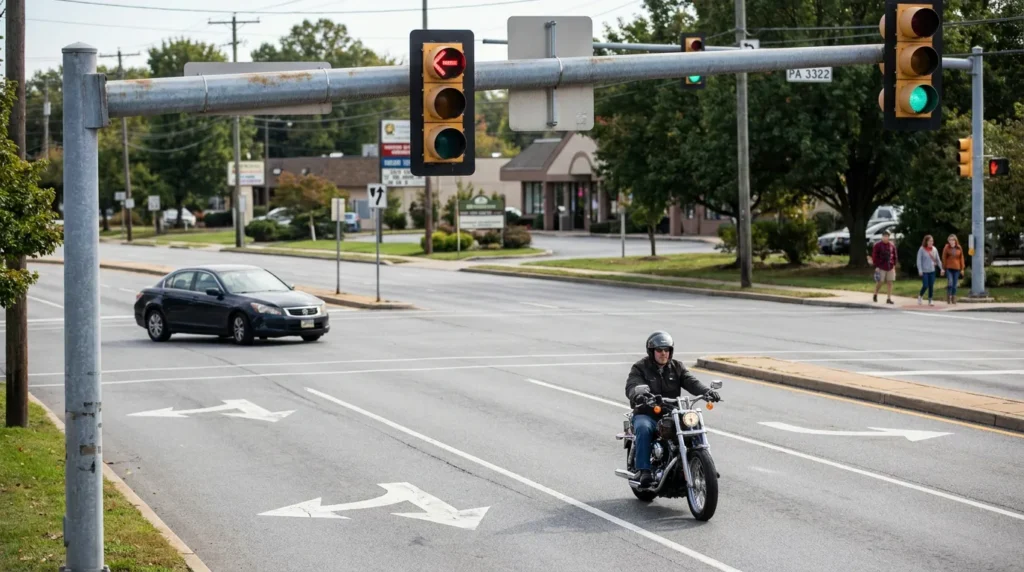
Turn-related collisions illustrate how quickly liability disputes develop. Many serious motorcycle crashes involve a driver who turns across a rider’s path. This discussion of what happens when a left-turning driver hits a motorcycle explains how fault is typically evaluated.
Preserving Evidence in the Days After a Crash
Evidence in motorcycle cases can degrade quickly. Practical steps include:
- Preserve the helmet, jacket, and boots in post-crash condition
- Photograph the roadway, skid marks, sightlines, and vehicle damage
- Obtain the police crash report and identify independent witnesses
- Follow through with medical care so records reflect the injury timeline
- Avoid posting about the crash on social media while a claim is pending
💡 Pro Tip: If your helmet was damaged, do not send it to an insurer. It is physical evidence that may corroborate impact force and traumatic brain injury mechanism.
Common Misunderstandings About Motorcycle Helmet Rules in Pennsylvania
Several recurring misconceptions cause riders problems. The first is believing that turning 21 alone creates an exemption. Age is a threshold condition that must be paired with either two full calendar years of motorcycle licensure or an approved safety course.
A second misunderstanding involves out-of-state riding. Helmet rules vary considerably across state lines, and a Pennsylvania exemption generally does not travel with you. The IIHS maintains a comparative motorcycle helmet laws table for multi-state trips.
A third involves enclosed-cab vehicles. Under § 3525(d)(1), an operator or occupant of a three-wheeled motorcycle with an enclosed cab is generally exempt, but the exemption is tied to enclosed cab configuration, not three wheels generally. Open trikes do not automatically qualify.
Building a Motorcycle Injury Case in Pennsylvania
Serious motorcycle crashes produce catastrophic injuries, including traumatic brain injuries, spinal cord damage, amputations, and severe road rash. Proving both liability and full damages typically requires medical documentation, wage records, and sometimes reconstruction analysis. Our team handles motorcycle accident claims for riders and families throughout Pennsylvania.
Timing matters. Pennsylvania generally applies a two-year statute of limitations to personal injury and wrongful death actions under 42 Pa.C.S. §§ 5524 and 5524(2). Courts often interpret exceptions narrowly. Claims against Commonwealth or local government entities are generally subject to a separate six-month written notice requirement.
Frequently Asked Questions
1. Does the helmet exemption apply if I just got my Class M license at age 30?
Generally no, unless you completed an approved course. The exemption requires that you be 21 or older and have either been licensed to operate a motorcycle for two full calendar years or completed a PennDOT- or MSF-approved rider safety course.
2. Can my passenger ride without a helmet if I am exempt?
If you are exempt and your passenger is 21 or older, that passenger is generally also exempt. Passengers under 21 generally remain covered regardless of your status.
3. Am I still required to wear eye protection if I qualify for the helmet exemption?
Generally yes. Pennsylvania’s eye protection requirement in § 3525(b) operates separately from the headgear rule, subject to limited exceptions such as an approved windscreen or enclosed cab.
4. Will not wearing a helmet prevent me from recovering compensation?
Not by itself. Fault generally turns on the other driver’s conduct, though insurers may raise the issue during negotiations. Pennsylvania’s comparative negligence rule can affect outcomes depending on specific facts and injuries.
5. How do I prove I completed an approved safety course?
Retain your course completion documentation and keep a copy accessible. Contemporaneous records are generally the most reliable proof if questioned.
What Riders Should Take Away
Pennsylvania’s helmet framework rewards experience and training while protecting newer and younger riders. The pa motorcycle helmet law 3525 exemption generally reaches riders 21 and older with two full calendar years of motorcycle licensure or an approved safety course, may extend to qualifying passengers 21 and older, and generally does not extend to learner’s permit holders. Equipment standards, eye protection rules, and DOT certification requirements remain in force regardless of exemption status.
If another driver’s negligence left you or someone you love seriously injured, do not let an insurance adjuster define your claim’s value. Reach out to The Injury Pros by calling 215-642-2335 or request your free consultation today.
Disclaimer: This content is for informational purposes only and is not legal advice. Every case is unique, and results may vary. Consult an attorney about your specific circumstances.